

Technical Basis
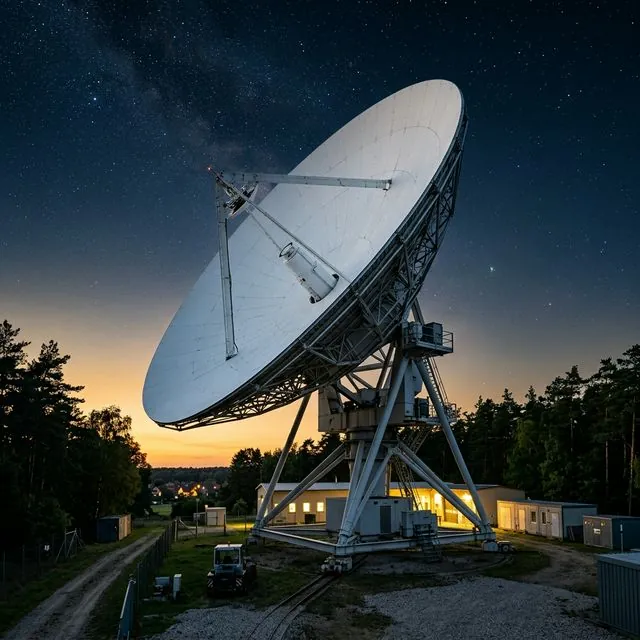
The facility is based on a former satellite antenna that has been modernised and calibrated for scientific use.
The FUTURA Radio Observatory in Neu Golm is part of a larger scientific and technical project and was accepted into NASA's Artemis II tracking programme in 2026.
The detailed report describes the reactivation of the FUTURA Radio Observatory, the application to NASA, the technical preparations and the successful reception of Orion signals during Artemis II.
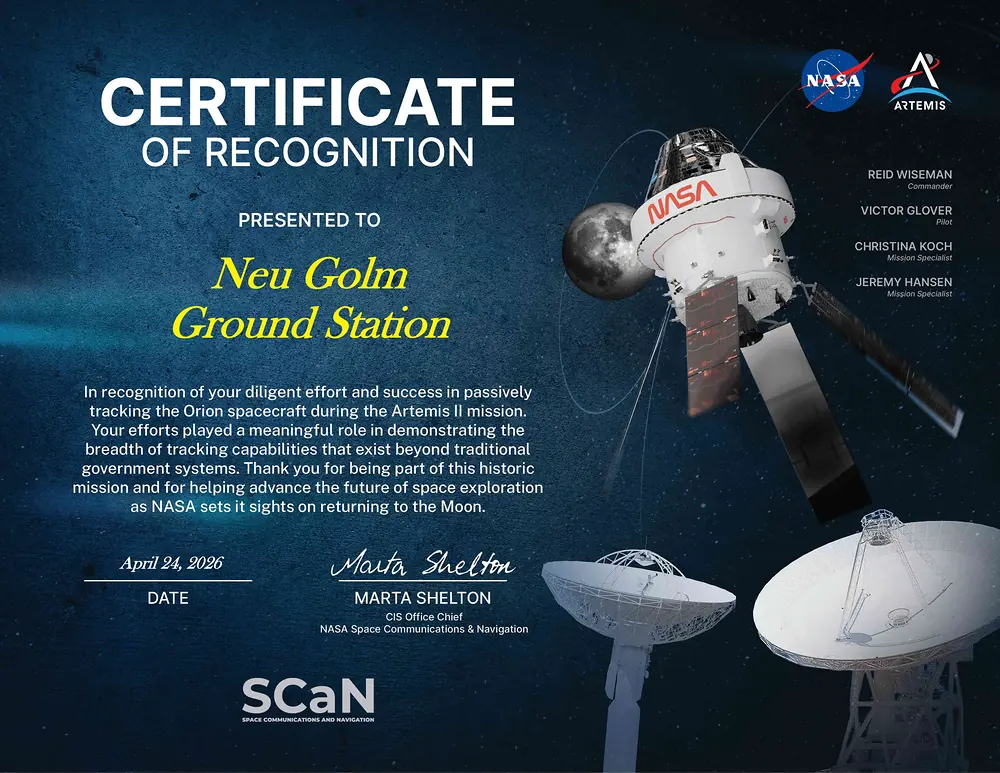
Read the ReportWith a Certificate of Recognition, NASA Space Communications and Navigation honours the Neu Golm Ground Station's successful contribution to passively tracking the Orion spacecraft during Artemis II.
The radio observatory is based on a modernised 12-metre satellite antenna from the 1970s. Today it is used for radio astronomy projects as well as educational formats.
The facility is based on a former satellite antenna that has been modernised and calibrated for scientific use.

Dr.-Ing. Andreas Fischer has played a decisive role in reactivating and developing the facility and has worked for several years to build up the infrastructure.

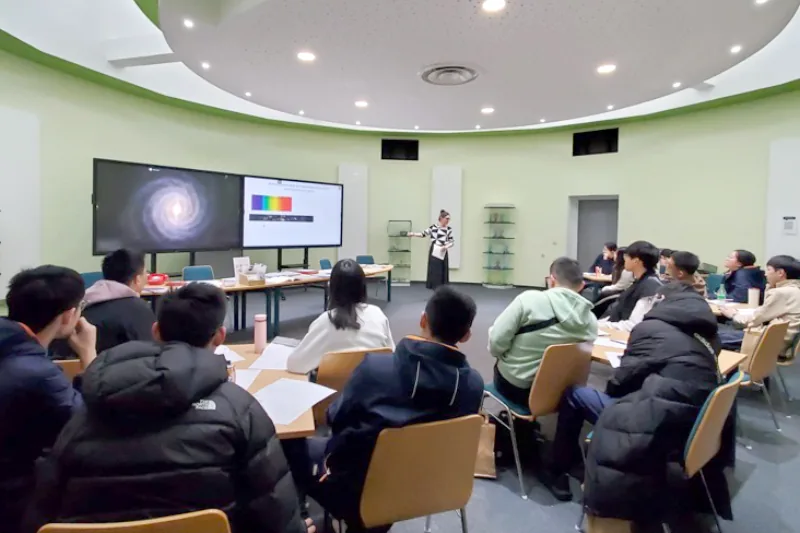
School pupils and students are to gain access to real scientific work and learn at a facility that can be used professionally.
Artemis II is part of NASA's Artemis programme and is the first crewed flight in that programme. Its aim is an orbit around the Moon in preparation for future lunar missions.
In 2026, the FUTURA Radio Observatory was accepted into the NASA tracking programme for Artemis II. This makes the facility part of a selected group of stations involved in evaluating radio signals.
Its inclusion in the programme is a special recognition of the facility's technical development and calibration.
During the mission, the frequency shift of a radio signal transmitted by the Orion spacecraft is recorded. Motion data for the capsule can be derived from this Doppler shift.
The facility records the radio signal transmitted by the Orion capsule during the flight.
The change in the signal is analysed and technically evaluated via the Doppler shift.
The measured values make it possible to determine the capsule's motion data along its flight path.
Artemis II shows how technical infrastructure, educational work and scientific ambition can come together at the same site.